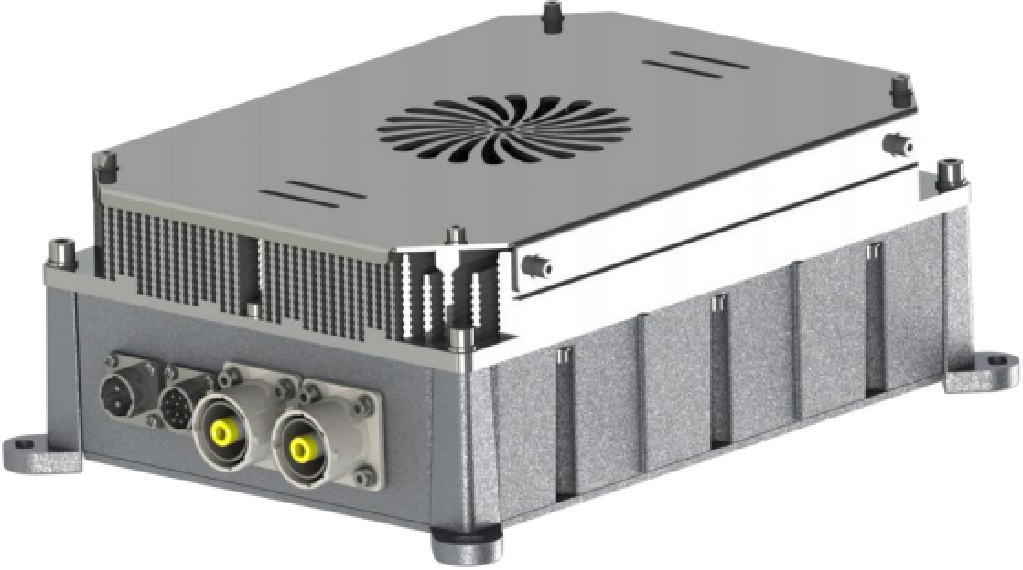
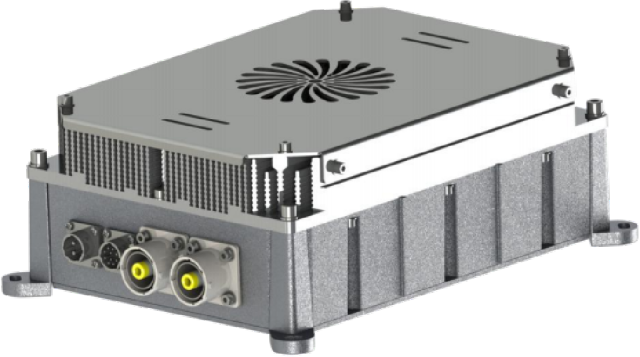
An on-board inverter is the part of a vehicle platform that turns battery DC into ordinary mains AC. This 3 kW assembly delivers 90–265 VAC at 50 Hz with a rated output current of 15 A from a full digital control stage running SPWM pure sine wave modulation, so AC appliances, tools and test equipment behave on vehicle power the way they behave on grid power instead of buzzing, overheating or dropping out.
The hardware is built to be designed into a vehicle rather than carried in a bag. A die-cast aluminum housing sealed against dust and water covers a phase-shifted full-bridge soft-switching DC-DC stage built on IGBT power devices, and forced-air cooling holds the heat sink inside its working band in an enclosed bay. As a dc to ac power inverter its duty is continuous rather than occasional: dc dc converter manufacturers specify it once with the vehicle wiring, and it stays with the platform for the life of the vehicle.
That is the difference between this unit and a portable inverter. Builders of RVs, motorcycles and special-purpose electric vehicles specify it into the electrical architecture, wire the AC side into a distribution panel, and control it from the vehicle controller over a CAN network, where status and parameters can be read and adjusted while the vehicle is running.
| Parameter | Rating |
|---|---|
| Vehicle power supply type | Vehicle inverter |
| Rated output power | 3000 W |
| Output voltage range | 90–265 VAC |
| Rated output voltage frequency | 50 Hz |
| Output frequency range | 45–65 Hz |
| Rated output current | 15 A |
| Output voltage THD | ≤5% |
| Output response time | ≤200 ms |
| Typical efficiency | ≥92% / ≥90% |
| Cooling method | Forced-air cooling |
| Communication function | CAN network |
| Charging function | Runs on received charging instructions; without a command the unit stays in standby |
Protection on this unit is staged rather than all-or-nothing. If the DC input drifts outside its window, or the AC output moves over or under voltage, the unit shuts down and brings itself back when the condition clears. No manual reset, no fuse to replace, no service call for a vehicle that is already back in spec.
The output side behaves the same way: a short circuit or a reverse-connected load trips the unit into shutdown and it recovers on its own once the fault is removed. That matters more than it sounds in vehicle wiring, because integrators and dc dc converter manufacturers building this unit into a larger on-board assembly do not have to design a latched reset circuit around it. Check the wiring before restarting, though — the protection saves the hardware, it does not correct a miswire.
Heat is handled in two stages. Once the heat sink passes 75 °C the unit reduces output power rather than cutting out, so AC loads keep running at a lower ceiling; above 95 °C it disconnects, and it restores output only after the sink falls below 85 °C. That ten-degree gap between trip and restore is what stops the unit cycling on and off at the limit. Because the thresholds are measured at the heat sink and not in the surrounding air, the mounting position you choose has a direct effect on the continuous power you can actually draw.
| Parameter | Rating |
|---|---|
| Over- and under-voltage protection | Self-recovering shutdown on both input and output |
| Output short circuit and reverse connection | Self-recovering shutdown |
| Over-temperature behavior | Staged: power derate, then disconnect, then automatic restore |
| Operating ambient temperature | -40 °C to +65 °C |
| Relative humidity | 5%–95% |
| Dust and water protection | IP67 |
| Product size | Confirmed with your quotation |
| Product weight | ≤3 kg |
The architecture is modular and fully digitally controlled, which changes what a platform variant costs you. The control stage, the power stage and the I/O are separable design blocks, so a different connector set, a different command table or a trimmed output arrangement can be accommodated without re-engineering the whole assembly — useful when one inverter has to serve several models in a vehicle family.
Soft switching and IGBT devices are the two choices that decide how the unit behaves on a real vehicle. Soft switching cuts switching losses along with the high-frequency noise that comes with them, so there is less to filter on the vehicle wiring and less interference to chase during electromagnetic compatibility work. IGBT devices tolerate the surge and impact conditions a road vehicle produces far better than the small-signal alternatives used in bench supplies. As a power inverter manufacturer we build the whole on-board family on this base, so control philosophy and CAN behavior stay consistent across a platform.
Efficiency is a thermal figure as much as an energy one. Every point of loss removed is heat that does not have to be moved out of a sealed housing, which is why 3 kW can be held in a forced-air-cooled, IP67-rated package instead of a liquid loop. Teams at dc dc converter manufacturers tend to judge this unit by the same measure they apply to their own converters: how much continuous power they can pull at a given ambient, and what happens when that limit is reached. Here the answer is a documented derate at 75 °C, a clean disconnect at 95 °C and automatic recovery, with CAN data available throughout so the behavior shows up in logs instead of being guessed at.
Every unit is quoted against a configuration rather than shipped from stock, because the parts that matter — DC input class, connector set, AC output arrangement and CAN command table — are decided per platform. The inverter is built in four DC input classes: 540 V nominal covering 400–900 V at up to 7 A, 360 V covering 200–450 V at up to 10 A, 72 V covering 60–100 V at up to 45 A, and 48 V covering 40–70 V at up to 60 A. Send us your pack's maximum and minimum voltage, the vehicle type, the continuous AC load you expect and the ambient the unit will live in, and we will confirm the build and treat it as a custom dc power supply matched to your platform rather than a fixed catalog item.
Dimensional drawings and the exact weight are issued with the quotation, since the sealed housing differs slightly between input classes. Units are packed for export with the housing protected against shock and moisture; tell us if your inbound logistics or your own production line needs a particular carton format or labeling. Lead time, payment terms and shipping arrangements are confirmed with your sales contact at the time of order, and repeat orders against the same configuration are straightforward once the build is on record. Ask your sales contact about sample availability and the documentation pack if you need to run the unit through an internal qualification step.
After delivery we stay involved: integration support, technical consultation and maintenance advice for the inverter and the surrounding on-board system, plus fault diagnosis and replacement support if a unit does not perform as specified. Bring us the CAN logs and the operating conditions and we can usually tell you what the unit was doing and why.
Buying power-conversion hardware rarely fails on the unit itself; it fails on the match. Tell our engineers the input and output voltages, the current your load draws and how the unit will be controlled and mounted, and they will confirm the right configuration or quote a customized one. Lincoren has run its own full-power R&D platform and pilot base in Nanjing since 2010, so selection, wiring and commissioning questions go to the people who designed the unit, not to a call centre. Fault diagnosis and replacement support continue after delivery.
Power conversion runs on IGBT devices in a phase-shifted full-bridge soft-switching DC-DC stage, and the housing is die-cast aluminum rated IP67, which gives the unit its dust and water resistance together with its resistance to impact on a vehicle. Cooling is by forced air through the housing, and the whole assembly is built as a sealed on-board component rather than an open-frame bench unit — the material and assembly choices a power inverter manufacturer makes when the part has to live on a vehicle for years.
Yes. The architecture is modular with full digital control, so the DC input class, connectors, AC output arrangement and CAN command table can all be agreed for a specific platform. Send us the pack voltage window, the loads you intend to run and the controller you are working with, and our engineers will confirm what the custom dc power supply build looks like before you commit to a design freeze.
Plan for airflow and access first. The unit is forced-air cooled, so its intake and exhaust need clear space and it should sit away from the hottest part of the bay. It mounts on a simple bracket, but keep it off flexing panels and do not let the cable bundle carry its weight. Keep the sealing intact when you route cables, and wire the AC output into a distribution panel within the 15 A rated output current.
The output is SPWM pure sine wave, rated at 50 Hz with a 45–65 Hz range, at 90–265 VAC and 15 A, with total harmonic distortion at or below 5% and the output settling within 200 ms. In practice, motors, compressors and electronics see a waveform close enough to mains that they run without the derating and audible noise a modified square wave produces. As a dc to ac power inverter built for continuous duty, it holds that quality while the vehicle is working, not only at start-up.
The unit is command-driven. It receives charging instructions over the CAN network and runs normally while those instructions are present; with no command it stays in standby instead of producing output on its own. That keeps the AC side inert until the vehicle tells it otherwise, which is the behavior most platform controllers expect from an on-board inverter.